By Amey Godbole
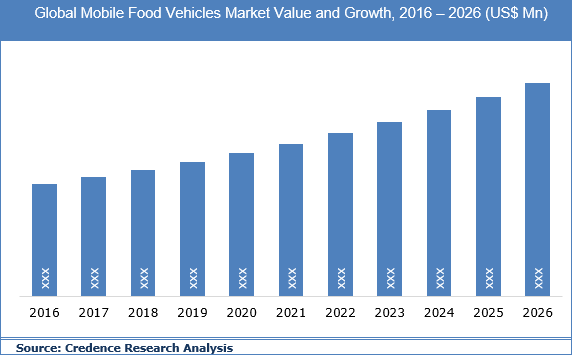
Mobile Food Vehicles Market (by Type (Food Trucks, Food Carts, Food Trailers, and Food Bustaurants), by Geography (North America, Europe, Asia Pacific, and Rest of the World)) - Growth, Future Prospects, and Competitive Landscape, 2018 -2026”, the global mobile food vehicles market is expected to expand at a CAGR of 4.9% during the forecast from 2018 to 2026.
Market Insights
On the flip side, in spite of strong growth experienced over the last few years, unfavorable regulatory environment will pose challenge to the growth of the mobile food vehicle market. In order to sustain your business, mobile food vehicle owners are required to obtain costly permits, ensure timely vehicle maintenance and insurance, find public or private parking spaces, and deal with employee licenses among others.
Food Trucks to Dominate Throughout the Forecast Period
Food trucks remain the preferred choice for most food vendors in the mobile food industry, accounting for majority of the market value share in 2017. The major reason behind their popularity is their range in sizes and mobility. While other variants like food carts and food trailers need a secondary vehicle in order to tow them, food trucks can commute with their own power. Thus, mobility remains the overriding factor for popularity of food trucks over other variants. On the other hand, with less space requirements, food carts incur relatively lower costs for operation (electricity & propane); thereby offering opportunity for vendors to keep prices lower than those of other mobile food vehicles.
North America to Lead; Asia Pacific to Register Strong Growth during the Forecast Period
In 2017, North America was the largest mobile food vehicles market worldwide, closely followed by Europe and Asia Pacific respectively. The value share of North America in the global mobile food vehicles market stood at over 40% of the global market value in the same year. This dominance can be largely credited to strong growth observed in the U.S. food truck industry over the last few years. Since recovering from the economic recession, the food truck industry in the U.S. has demonstrated an average growth of 7.5% per year. However, it is presumed that after witnessing promising and sustained growth for last five years, the food truck revenue will slow down, thereby affecting new sales of food trucks and growth of the mobile food vehicles market in the U.S.
Some of the leading players profiled in the study include Prestige Food Trucks, M&R Trailers & Trucks, Custom Concessions, Prime Design & Food Trucks, Food Truck Stop, LA Stainless Kings, Newark Food Trucks, and Caged Crow Fabrications among others. In order to sustain in the market, mobile food vehicle manufacturers compete on the basis of turnaround time, quality, and competitive pricing. Due to the overall growth in the mobile food vending industry across different work sites, the notion that ‘one size fits all’ is no longer applicable. This has pushed mobile food vehicle manufacturers to offer custom-made food vehicles capable of serving specific needs across multiple jobsites. Manufacturers are also striving to build strong associations with restaurant groups, corporations, universities, and government facilities among others so as to retain bulk of their revenue stream.

Amey Godbole (Editor)
Amey Godbole is a Senior Research Analyst working with Credence Research since its inception. He has an experience of market research in the fields of E-commerce, Information Technology (IT) Services & Solutions and Electronics segments. Amey has completed B.E. with specialization in Electronics & Telecommunication from University of Mumbai and MBA in Marketing.
Contact:
Email: Amey@industrynewsupdate.com
Mo. No. 919719670423
Comments
Post a Comment