Inspection Robots Market expected to grow at a CAGR of 17.3% during the forecast period from 2018 to 2026
By Amey Godbole
Inspection Robots Market (Type – Autonomous and Remotely Operated Vehicles (ROVs); End-use Industry – Oil & Gas, Petrochemicals, Utilities, Food & Beverages and Automotive) – Growth, Future Prospects and Competitive Analysis, 2018 – 2026”, the global inspection robots market expected to grow at a CAGR of 17.3% during the forecast period from 2018 to 2026.
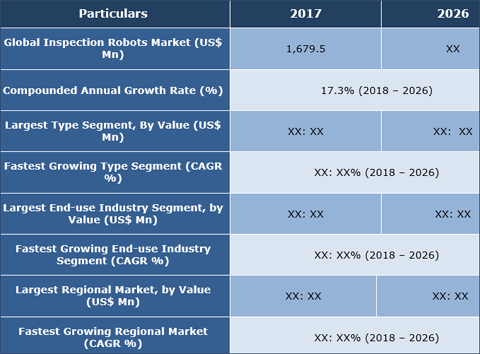
Inspection robots market was valued at US$ 1,679.5 Mn in 2017 and expected to grow at a CAGR of 17.3% during the forecast period from 2018 to 2026. The fact that robotic inspection has proved to be significantly advantageous over current methods of inspection has led to its increasing adoption across various applications. The ability to operate in harsh, hazardous & dirty environment and to assist human inspectors 24/7 supports the aforementioned statement. For instance, inspection robots are finding wide application in the petrochemical industry for the purpose of inspection of assets. The huge potential of robotics in the petrochemical industry has benefited inspection robots to become an integral part of inspection and maintenance strategies.
Increasing focus towards generating positive cash flow in the long run is one of the most prominent factors complimenting the demand growth for inspection robots. Robotic implementation enable businesses to achieve better return on investment as they greatly minimize labor costs and at the same time helps to achieve higher operational efficiency. Moreover, the fact that, availability of skilled labor is becoming an issue of concern and process of hiring, training and retaining such employees involves high cost, further aids the adoption of inspection robots in order to achieve a higher profit margin.
Market Synopsis
With Operational Costs Cutting Deep Into Profits, Oil and Gas Companies Are Adopting Automation Technology
End-user industries such as automotive and food & beverages across the world in order to maintain operational efficiency are opting for automation of critical applications. Earlier, the tasks that were carried out through manual inspection are increasingly inspected through robotic inspections. For instance, industries such as petrochemical, oil & gas and food & beverages are extensively deploying inspection robots in order to improve detection and minimizing of anomalies and deviations in the existing processes. Therefore, to facilitate smooth and efficient processes and ensure products to meet quality standards, the demand for inspection robots expected to remain high in the years to come.
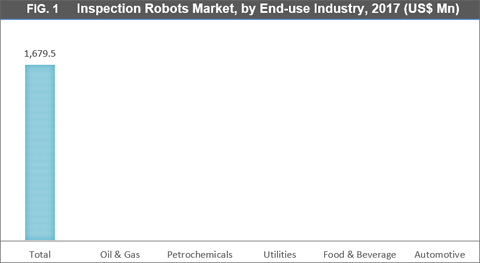
In 2017, the oil & gas segment led the overall inspection robots market worldwide, contributing to more than 50% of the overall market value in 2017. The inspection of critical components such as pipes, reactors, columns, pressure vessels, tank boilers is of prime importance in the oil and gas industry. The application of inspection robots in the oil and gas industry has brought considerable improvements in monitoring the condition of key components. In the oil and gas industry, each structure over the period of its operational life is exposed to harsh environments, such as high pressure, extreme temperatures and corrosive chemicals thus becoming prone to heavy wear and tear. This in turn might cause cracks, leakages and dents. Thus, the function of inspection robots in this context becomes immensely important in order to avert any disasters that may occur otherwise.
Increasing Focus towards Inspection of Critical Components across Industries in North America to Drive Demand In The Region
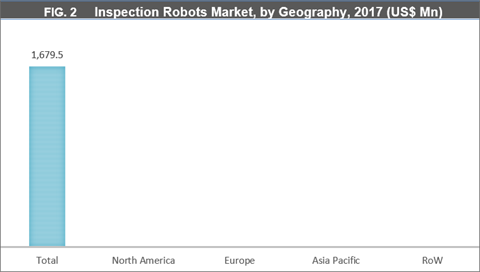
The global inspection robots market is dominated by North America accounting for more than 30% of the overall market value in 2017. The region is further expected to continue its dominance throughout the forecast period. One of the most prominent factors aiding the demand for inspection robots in the region can be attributed to its high adoption across end-use industries such as oil & gas, petrochemical and utilities industry. Moreover, the fact that the oil and gas industry is expected to recover in near future will further influence the demand for inspection robots in the region.
R&D Activities Directed Towards Product Enhancements
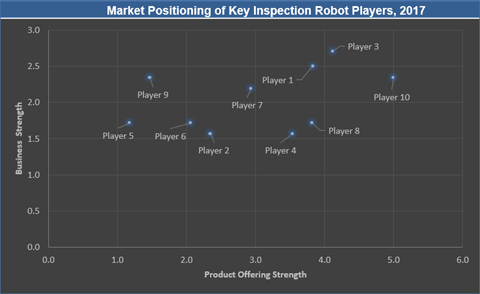
Research and development is one of the most common strategies amongst players in the inspection robots market. These research and development activities are directed towards improving the existing products and developing new robots with enhanced functionalities and improved efficiency. For instance, recently, Mitsubishi Electric Corporation introduced a 19.9 mm thin inspection robot capable of inspecting power generators. The small size of the robot enables it to pass through the narrow gap between stator and the rotor, thereby eliminating the need to remove the rotor. The robot greatly improves the reliability and reduces cost and time of inspections. Similarly, in March 2018, Hydro-Québec unveiled a functional prototype of its power line inspection robots, the LineRanger. The new robot facilitates efficient inspection of conductor bundles on high-voltage transmission lines.
Historical & Forecast Period
2016 – Historical Year
2017 – Base Year
2018-2026 – Forecast Period
This research report presents the analysis of each segment from 2016 to 2026 considering 2017 as the base year for the research. Compounded Annual Growth Rate (CAGR) for each respective segments are calculated for the forecast period from 2018 to 2026.

Amey Godbole (Editor)
Amey Godbole is a Senior Research Analyst working with Credence Research since its inception. He has an experience of market research in the fields of E-commerce, Information Technology (IT) Services & Solutions and Electronics segments. Amey has completed B.E. with specialization in Electronics & Telecommunication from University of Mumbai and MBA in Marketing.
Contact:
Email: Amey@industrynewsupdate.com
Mo. No. 919719670423
Comments
Post a Comment